

Share this
by Tim McLain on August 19, 2026
The email arrives on a Tuesday. A corporate client wants to outfit 400 employees for a sales kickoff, or reward a top performing team, or send something to every new hire this quarter. They have a budget, a date, and no idea what sizes anyone wears.
What happens next tells you whether your brand treats employee merchandise as a revenue line or as an interruption.
Most apparel brands treat it as an interruption. The request goes to whoever has capacity, gets quoted awkwardly, and often gets handed off to a third party gifting company because nobody internally has the bandwidth to run it. The order gets fulfilled. The margin goes somewhere else. The relationship becomes a vendor's relationship rather than yours.
That is a solved problem now, and the solution looks less like a new business unit than like a storefront you can build in an hour.
Employee merchandise programs and incentive programs are one of the few genuinely additive revenue lines available to a wholesale apparel brand. They just require a way to sell branded merchandise to a defined group of people, once, without shipping anything on a guess.
The Demand Is Already Coming In
OluKai lived exactly this. Corporate event inquiries were arriving faster than the team could handle them, and the team was one person.
"I'm a team of one working on these corporate events," said Hillary Wiebe, Corporate Sales Specialist at OluKai. "We were getting overwhelmed with the amount of inquiries and events people wanted to do, so we started working with a third party gifting company to facilitate these events on our behalf because we didn't have the resources on our end. But these events weren't as profitable for us through these third parties, if we do it directly it's way more profitable."
Read the sequence. Demand exceeded capacity, capacity was outsourced, and profit went with it. That is not a sales problem. It is a fulfillment workflow that never got built.
"Microsites have been a way for us to capture more business and keep relationships direct," said Wiebe.
Why the Old Way Breaks
Before there was a digital option, employee and corporate merchandise ran two ways and both had structural problems.
Ship on an estimate. OluKai used to send hundreds of pairs of shoes to an event based on projected attendance. Nobody knew whether the sizing was right. The client sometimes had to pay to store product near the venue. Somebody had to staff the event just to unpack boxes. Whatever did not move came back or did not.
Send gift cards to your consumer site. This works, technically. It also strips out everything that made the program feel like a program. The recipient lands on your full consumer assortment instead of the curated selection the client chose, there is no branded moment, and the client has no control over what gets picked.
Both approaches share the same flaw. They guess at demand instead of capturing it.
A Digital Pop Up Shop Instead
A microsite is a custom storefront that sits separate from your main B2B site, built for one program, one audience, and one window of time. Think of it as a digital pop up shop rather than as one of the permanent company store platforms your clients may have looked at, because permanence is exactly what most of these programs do not need.
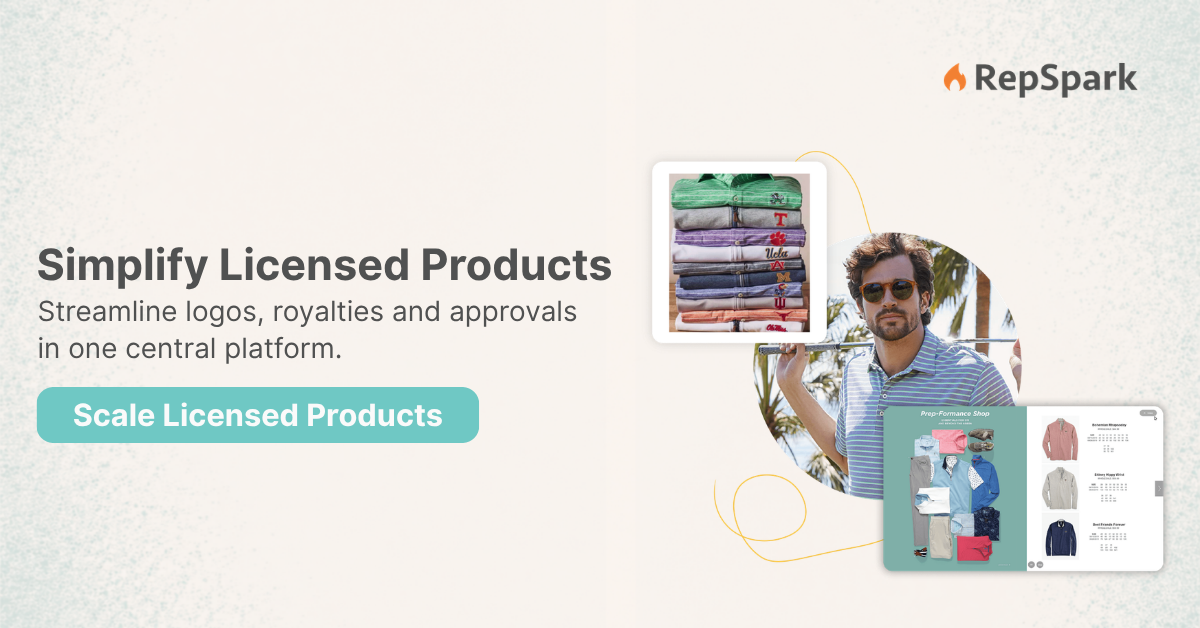
The mechanics are simple and they invert the problem. Your client picks the exact products they want offered. You invite the specific people who are eligible. Each person orders their own size. Product ships to their home, often before the event even happens. When the window closes, the storefront closes.
Nobody guessed. Both sides know the exact quantity needed because the recipients told you.
For an event, that eliminates onsite storage, unpacking labor, and leftover inventory in one move. Recipients can even receive a shipment with a personalized note from the client, which is another branded touchpoint the gift card approach cannot produce.
Southern Tide has used the same capability to run custom pop up programs for tournament and club events with their retailers. Straight Down ran more than 70 microsites in a single year, averaging over 11,000 dollars in revenue per event. "Microsites allowed us to keep serving customers even when golf shops were closed," said Robert Ogden.
And Wiebe now builds a microsite for an event in under an hour.
What Turns an Event Store Into an Employee Program
This is where the distinction matters, because a one time event store and an ongoing employee merchandise program need different controls. Four settings do most of the work.
Ordering limits by value or unit count. You can cap what any one person orders, either by dollar value or by number of units. That single setting is how employee rewards and incentive programs actually get implemented. Give every employee a 150 dollar allowance and the platform enforces it, rather than someone reconciling overspending after the fact.
Show or hide pricing. Retail and wholesale prices can each be displayed or hidden. For a gifted program this is essential. The employee choosing a jacket does not need to see what their company paid for it, and the client does not want them to.
Product packages with ordering rules. Curate bundles rather than a loose catalog, with custom sorting and notes attached to each package. A new hire kit, a tier one incentive reward, and a tier two reward can be three defined packages instead of three conversations.
Bulk user invitation and status tracking. Invite the whole employee list at once, then filter for who has not been invited, who is pending acceptance, and who is active. For a 400 person program that difference is the difference between a workable rollout and a spreadsheet.
Two more operational details worth knowing. Orders can be split automatically based on whether items need decoration, which keeps embroidered pieces on the right fulfillment path. And RepSpark Pay can accept card payments directly from the shopper, which matters when employees are contributing part of the cost rather than the company covering everything.
Why This Is a Sales Program, Not a Perk
The reason to build this is not employee satisfaction at your client's company. It is that corporate and employee programs reach buyers your wholesale channel does not.
An employee ordering a jacket through their company store may never have set foot in a store that carries you. They are receiving your product with a positive association attached, at no acquisition cost to you, inside a transaction your client paid for. That is a category of exposure your normal distribution cannot buy.
It also does not cannibalize anything. This inventory is not competing with your retail partners for the same customer, which makes it one of the few genuinely additive channels available to a wholesale brand.
EssilorLuxottica made a version of this argument about branded RepSpark microsites for Oakley and Ray Ban. "Through branded customer microsites, the platform extends selling beyond traditional appointments, enabling always on access to our assortments, and helping us capture incremental sales while strengthening customer relationships," said Ewan King, Business Development Manager at EssilorLuxottica.
Incremental sales and stronger relationships. Employee merchandise programs deliver both, from clients who came to you asking.
Where RepSpark Fits
Event microsites are part of RepSpark, alongside branded portal pages, online order entry, digital catalog and line sheet creation, sales management, and sales insights.
That matters for a practical reason. The employee program is not running in a separate tool with its own login, its own product data, and its own reconciliation. It draws on the same product information and the same order management as the rest of your wholesale business, which is why one person can run dozens of programs a year without a dedicated team.
Wiebe's own goal was not to double the number of microsites. It was to double the profit running through them, and she told her manager she thought it was attainable specifically because turning them around had become so easy.
How to Start Without Building a Department
Pick one client who has already asked.
Build a single microsite with a narrow curated assortment, a defined open and close date, an ordering limit per person, and pricing hidden. Invite the list. Watch what happens.
Then measure three things. Revenue per program, which is your unit economics. Hours spent per program, which tells you how many you can run. And how many recipients had never bought your brand before, which is the number that tells you whether this is a fulfillment channel or an acquisition channel.
Do not build a corporate gifting division. Build one storefront, prove the model, and let the inbound requests you are already receiving tell you how big it should get.
RepSpark connects more than 100,000 retailers with brands and their sales teams, has been named to the Inc. 5000 list for five consecutive years, and maintains SOC 2 Type II and GDPR compliance. RepSpark Flow, the newest version of our software, is available now to new and existing customers.
The requests are already in your inbox. The only question is whether they route through you or through somebody else.
RepSpark connects more than 100,000 retailers to over 250 brands and their sales teams. RepSpark has been named to the Inc. 5000 list for five consecutive years and maintains SOC 2 Type II and GDPR compliance.
