

Share this
by Susan Gonzalez on August 12, 2026
Most wholesale apparel and footwear brands think about their buyer base in one direction: boutiques, specialty retailers, big-box accounts, maybe a golf pro shop or two. Meanwhile, there's a channel sitting right next to all of that generating real, recurring order volume that a lot of brands still aren't chasing on purpose — corporate accounts buying branded merchandise for their own employees.
Onboarding kits, work anniversary gifts, holiday sends, sales-incentive rewards, all-hands swag, new-hire welcome boxes — HR and marketing teams at mid-size and large companies are placing these orders constantly, often through whichever vendor made the process easiest, not necessarily whichever brand made the best product. If you sell quality apparel and you're not set up to sell it as employee merchandise, you're leaving a recurring revenue channel on the table for a promo products company to fill instead.
Why Corporate Gifting Is Bigger — and More Sophisticated — Than It Looks
Corporate gifting isn't a token gesture line item anymore; it's a real budget with real buyer expectations, and those expectations are shifting fast:
- Sustainability is now a real purchase driver, not a nice-to-have. Eco-conscious products made up roughly 14% of industry sales in a recent year, up about 20% year-over-year, and a meaningful share of employees say they value sustainability in swag more than anything else.
- Quality over quantity has become the default philosophy. Buyers are moving away from cheap, mass-produced giveaways toward fewer, better items — the same "quiet luxury" instinct reshaping retail is reshaping corporate gifting, favoring premium, subtly-branded pieces over anything that reads as a logo dump.
- Personalization and choice matter more than ever. Rather than shipping the same polo in the same size to everyone on a team, companies increasingly want employees to select their own size, color, and sometimes even the item itself.
- On-demand, inventory-free ordering is replacing bulk pre-buys. HR and marketing teams have gotten tired of guessing at sizes, storing boxes of leftover swag, and eating the cost of what nobody wanted. Self-service platforms where the recipient picks what they actually want — and the vendor fulfills on demand — are becoming the expectation, not the exception.
- Strategic, segmented programs are winning over one-size-fits-all swag. The best-run programs tailor assortments to specific teams, roles, or moments (new-hire kit vs. five-year anniversary gift vs. holiday send) instead of running one generic catalog for everyone.
Every one of those shifts favors real apparel and footwear brands over generic promo suppliers — if the brand can actually deliver the ordering experience buyers now expect.
The Old Way of Running These Programs Doesn't Work Anymore
Here's why so many good brands still aren't capturing this channel: the operational lift has historically been brutal. A corporate buyer wants a custom company logo on a curated assortment, individual employees need to self-select sizes without an admin manually collecting a spreadsheet, orders need to ship to dozens or hundreds of individual addresses instead of one warehouse, and none of that fits neatly into a traditional wholesale order form built for a single retail account placing one bulk PO.
That mismatch is exactly why this revenue stream gets overlooked — not because the demand isn't there, but because most brands' order infrastructure wasn't built to handle it.
How RepSpark Microsites Turn Corporate Gifting Into a Sellable Program
This is precisely the gap RepSpark's Event Microsites are designed to close. Instead of managing a corporate merchandise order through email threads and manual spreadsheets, a brand can spin up a branded, mobile-friendly storefront built specifically for that company's program:
- Curated assortments, brand-controlled. You pre-select which products, colors, and logo placements are available — so the corporate buyer isn't browsing your entire catalog, they're choosing from a program built for them.
- Employee self-selection. Individual employees log in, pick their own size and preferred item within the approved assortment, and check out — eliminating the spreadsheet-and-guesswork problem that makes traditional bulk swag orders so painful for HR teams.
- Flexible payment structures. Programs can run on company-paid budgets, employee credits, promo codes, or a predetermined assortment where everything is already covered — whatever fits how the corporate account wants to structure the benefit.
- Direct, drop-shipped fulfillment. Orders consolidate into a single summary for the brand, then ship straight from your warehouse to each individual employee — no separate inventory buffer required, and no manual re-packing and redistribution on your end.
- Fast to launch. Pre-built templates mean a new corporate program can go live without a developer building a one-off site from scratch every time you land a new account.
It's the same infrastructure that works for golf tournaments and fishing tournaments, applied to a channel with even more recurring potential: employee merchandise doesn't happen once a year, it happens with every new hire, every anniversary, every incentive push, and every holiday season.
Setting Up Custom Assortments With Corporate Logos
The other half of the equation is making sure the product itself can actually carry a corporate logo cleanly and at scale.
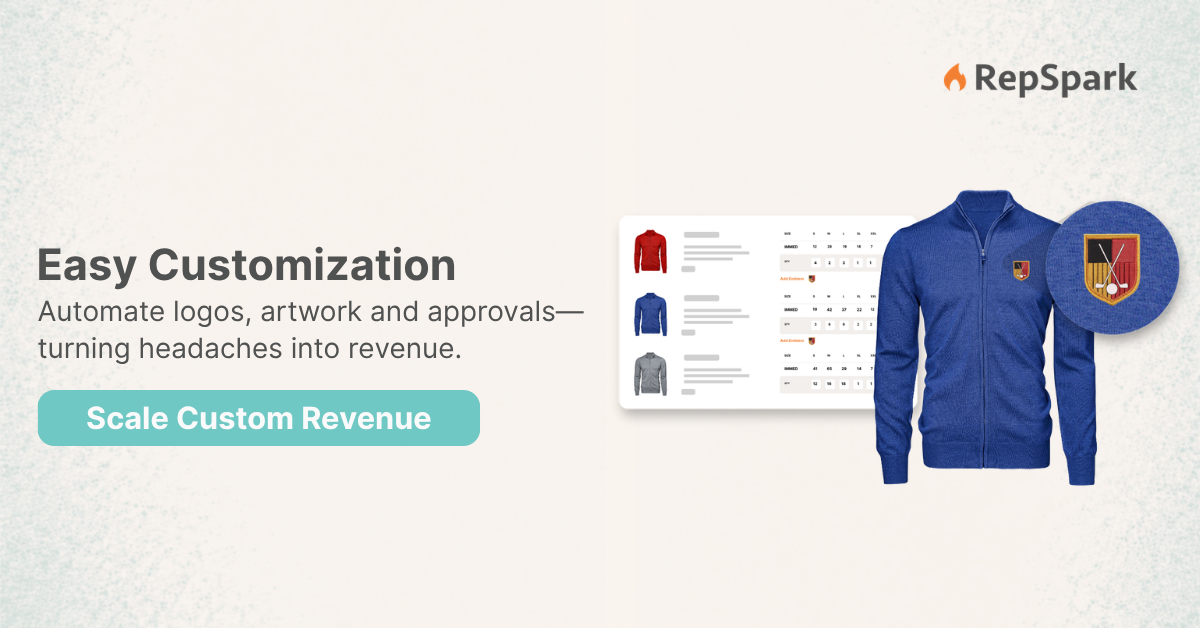
RepSpark's product customization tools handle this two ways, depending on what a brand needs:
For unrestricted corporate branding, the Insignia solution lets a brand (or the corporate buyer, within approved limits) upload a logo, select from approved garments and colors, and place that logo exactly where it needs to go — chest, sleeve, wherever the brand's guidelines allow. This is built specifically with use cases like corporate gifts and events in mind, and it's a big reason one RepSpark brand partner, johnnie-O, saw custom order volume increase 744% after implementing it.
For licensed merchandise — think league or collegiate logos alongside a corporate co-brand — the Licensing solution automates the compliance side: it restricts logo placement to what's actually allowed, calculates royalties automatically, and keeps assortments within the licensor's guidelines, so approvals aren't a manual bottleneck between your sales team and the corporate buyer.
Together, these tools mean the corporate logo isn't a special request that requires a one-off production run — it's a standard part of how buyers configure their order at checkout.
Fulfillment Without the Warehouse Headache
Drop shipping to dozens or hundreds of individual employees only works if your backend can actually handle it, which is where integrations matter more than most brands expect going in. RepSpark connects with fulfillment and warehousing partners like Fulfll and Blue Cherry, along with 20+ ERP systems including SAP, Oracle NetSuite, and Cin7, so an employee merchandise order flows through the same connected system as the rest of your wholesale operations instead of becoming a manual side process your ops team dreads every time a new corporate account signs on.
Pair that with tighter day-to-day B2B operations and branded selling tools for your sales team to pitch and manage these programs, and employee merchandise stops being a special project and starts being a repeatable offering your reps can sell into any corporate account.
Turning a One-Time Order Into Recurring Revenue
The real upside of this channel isn't the first order — it's what happens after. A company that orders 50 new-hire kits this quarter will need more next quarter. A holiday gifting program that goes well becomes an annual line item. A sales-incentive assortment that employees actually like gets requested again for the next incentive cycle. Brands using AI-driven order insights can track which items in a corporate assortment perform best and use that data to make the next program pitch — a renewal, an expansion to a new department, a seasonal refresh — an easier close.
The Bottom Line
Employee merchandise and corporate gifting aren't a side hustle for promotional products companies anymore — they're a real, recurring B2B channel that rewards brands with genuinely good product and an ordering experience that doesn't make HR teams do the work a platform should be doing. If you already sell wholesale, you already have the product. What most brands are missing is the infrastructure to sell it as a program instead of a one-off favor.
See how RepSpark's platform supports employee merchandise and corporate gifting programs end-to-end, from event microsites and product customization to fulfillment integrations, or check pricing to see what it takes to add this channel to your existing wholesale business.
Frequently Asked Questions
Q: What is an employee merchandise program? A: An employee merchandise program is a system that lets a company order branded apparel and gifts for its own employees — for onboarding, work anniversaries, holidays, sales incentives, or general swag — typically through a custom storefront where employees select their own size and item within an approved, company-branded assortment.
Q: Why is employee merchandise considered an overlooked wholesale revenue stream? A: Most wholesale brands focus on retail accounts like boutiques and specialty stores, and don't have the ordering infrastructure to handle corporate buyers who need custom logos, individual employee self-selection, and drop-shipped fulfillment to many addresses. That operational gap means real demand from corporate accounts often goes to generic promotional products suppliers instead of quality apparel brands.
Q: How does drop shipping work for employee merchandise orders? A: Instead of a company ordering in bulk and redistributing items internally, employees select their own items through a branded storefront, orders consolidate into a single summary for the brand, and the brand ships directly to each employee's address from its own warehouse or fulfillment partner — eliminating the need for the corporate buyer to hold or repackage inventory.
Q: How do brands add a corporate logo to products without a custom production run for every order? A: Product customization tools let a brand set approved garments, colors, and logo placement options in advance. Buyers then upload or select their logo and configure placement within those approved parameters at checkout, so the branding step becomes part of the standard ordering flow rather than a manual back-and-forth production request.
Q: What corporate gifting trends should wholesale brands know about right now? A: Sustainability is a growing purchase driver, quality is winning out over quantity, personalization and employee choice are increasingly expected, and on-demand, inventory-free ordering is replacing bulk pre-buys where a company guesses at sizes and quantities in advance.
Q: Is employee merchandise a one-time sale or a recurring revenue opportunity? A: It's typically recurring. Companies place new-hire kit orders continuously, repeat holiday and milestone gifting annually, and often expand a successful program to new departments or incentive cycles — making it one of the more durable repeat-order channels available to a wholesale brand.
Q: Do employee merchandise programs work for licensed merchandise, like league or collegiate logos? A: Yes, with the right tools. Licensing-aware product customization can automatically restrict logo placement to what's allowed under a licensing agreement and calculate royalties, so a corporate co-branded program involving licensed marks can still run through a standard self-service ordering flow.
Book a discovery call to learn more and see the RepSpark platform in action.
