

Share this
by Tim McLain on August 18, 2026
Employee merchandise programs used to be a side conversation for most apparel brands. A corporate buyer would call, ask for 200 polos with a company logo, and the order would get handled manually through a favor-based workflow nobody wanted to repeat. That approach left revenue on the table.
For modern apparel and activewear brands, employee merchandise and incentive programs represent a real, recurring wholesale channel. RepSpark helps brands turn these requests into structured programs with curated assortments, self-service ordering, and direct fulfillment to individual employees. Before you launch, here are nine considerations that will shape whether your program runs smoothly or becomes an operational burden.
Key Takeaways
- Platform selection determines whether your program scales or stalls under the weight of manual processes.
- Inventory strategy requires deciding between bulk pre-purchasing, on-demand production, or a hybrid approach based on volume.
- Employee self-selection eliminates the spreadsheet chaos that makes traditional corporate orders painful for HR teams.
- RepSpark's Event Microsites let brands spin up branded storefronts for corporate accounts with curated product assortments.
- Brand control matters more than flexibility when corporate logos go onto your products alongside your own.
What Apparel Brands Should Know Before Launching Employee Merch Programs
1. Platform Choice Determines Your Operational Load
The technology behind your employee merchandise program will either multiply your team's capacity or become a bottleneck. A platform that requires manual order consolidation, email-based size collection, and separate invoicing for every corporate account will exhaust your operations team before you reach five accounts.
Look for B2B management tools like RepSpark that automate order collection, consolidate fulfillment data into your existing workflows, and connect directly to your ERP. The goal is for a corporate merchandise order to flow through the same system as your retail wholesale orders.
2. Inventory Model Sets Your Risk Profile
Corporate gifting buyers increasingly expect on-demand ordering where employees select their own items and sizes. This eliminates the dead-stock problem that plagued bulk pre-purchase programs. A brand sitting on 300 medium polos nobody wanted now carries that cost indefinitely.
On-demand production shifts inventory risk away from both you and the corporate buyer. If your fulfillment partners support single-piece decoration and drop shipping, lean toward an inventory-free model for most accounts.
3. Employee Self-Selection Solves the Spreadsheet Problem
HR teams have historically collected sizes via email, compiled them into spreadsheets, and forwarded that mess to whoever was handling the order. That workflow is exactly why corporate gifting became a pain point instead of a program. When employees select their own size, color, and item through a branded storefront, you eliminate the admin overhead that makes these programs hard to repeat.
Event Microsites let employees log in, browse an approved assortment, and check out on their own. The brand receives a consolidated order summary while each employee gets exactly what they wanted.
4. Branding Guidelines Require Upfront Definition
Corporate accounts will want their logo on your products. Without clear guidelines for placement, color restrictions, and decoration methods, you risk approving something that looks wrong on the final garment or conflicts with your brand standards.
Define approved logo positions, decoration types (embroidery, screen print, heat transfer), and garment-color combinations before you open a program. RepSpark's product customization tools let you set these parameters in advance so buyers configure orders within your rules.
5. Curated Assortments Outperform Open Catalogs
Corporate merchandise buyers do not want to browse your entire product line. They want a focused selection built for their use case: onboarding kits, work anniversaries, sales incentives, or holiday gifts. A 12-item assortment with clear options will convert faster than 400 SKUs with no context.
Build program-specific storefronts with products selected for each account's purpose. Fewer choices, clearly organized, lead to higher order completion rates and fewer abandoned carts.
6. Fulfillment Must Support Individual Drop Shipping
The old model of shipping 200 items to a corporate office for redistribution is dying. Employees work remotely, across multiple offices, or on hybrid schedules. Your fulfillment strategy needs to support shipping directly to individual home addresses without requiring the corporate buyer to repackage and redistribute.
Confirm that your warehouse or fulfillment partners can handle single-piece decoration, individual packing, and direct shipping to dozens or hundreds of addresses from a single consolidated order. RepSpark's ERP integrations connect your storefront to fulfillment workflows so orders route automatically.
7. Payment Flexibility Expands Your Buyer Base
Corporate accounts structure merchandise benefits differently. Some pay the full cost upfront. Others give employees a credit or budget and let them top up for premium items. Some run promotional codes for specific campaigns. Your platform needs to support multiple payment structures without requiring a custom workaround for each account.
Programs that offer company-paid budgets, employee credits, promo codes, and predetermined assortments give sales reps more ways to position the offering. More flexibility means more accounts closed.
8. Licensed Merchandise Adds Compliance Complexity
If a corporate account wants to co-brand with a licensed logo, think league marks, collegiate insignia, or entertainment properties, you inherit a compliance obligation. Logo placement restrictions, royalty calculations, and approval workflows can slow orders to a crawl if handled manually.
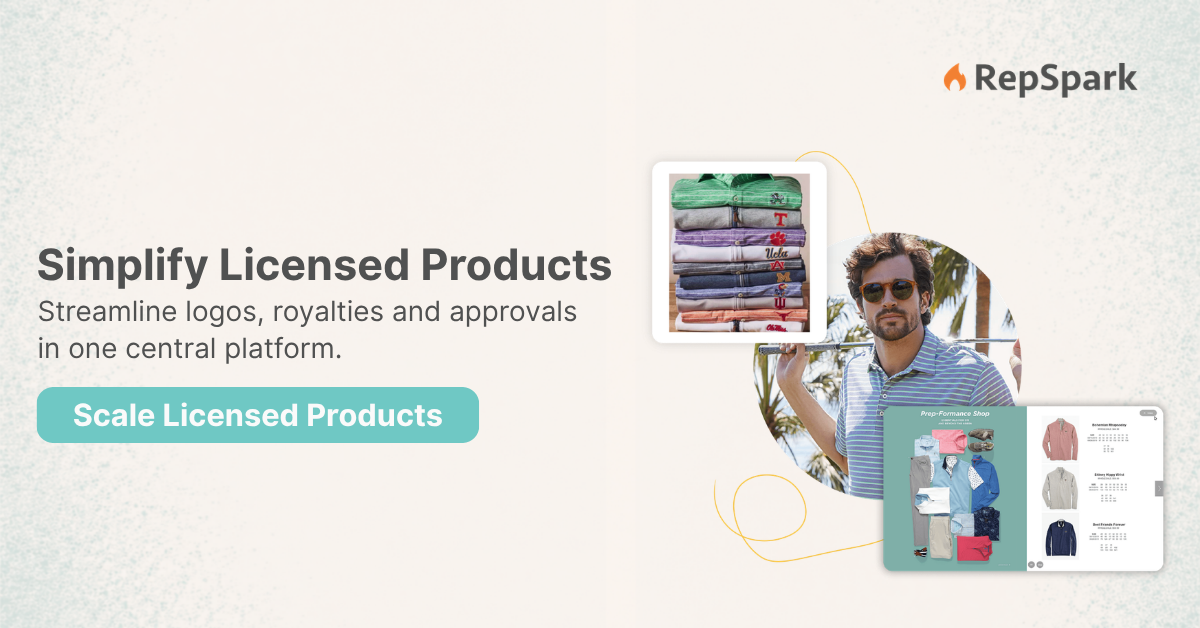
A licensing-aware platform automates the compliance layer: it restricts placement to approved positions, calculates royalties automatically, and keeps orders moving without manual back-and-forth with legal teams. If licensed merchandise is part of your opportunity, build this capability in from the start.
9. Recurring Revenue Requires a Renewal Strategy
The real value of employee merchandise programs is not the first order. It is what happens after. New-hire kits need refilling every quarter. Holiday gifting programs repeat annually. Sales incentive assortments get requested again for the next campaign. The brand that tracks which items perform, follows up before renewal windows, and proposes program expansions will capture more of that recurring revenue.
RepSpark's AI Order Insights surface which products in a corporate assortment sold through and which sat. That data makes renewal pitches concrete: "Your team ordered 40% more quarter-zips than polos last round. Want us to adjust the assortment?"
Why Employee Merchandise Programs Fit Your Wholesale Strategy
Apparel brands already have the product, the production capacity, and the brand equity that corporate buyers want. What most brands have been missing is the ordering infrastructure to sell employee merchandise as a structured program instead of a one-off favor. Building that infrastructure turns sporadic corporate requests into a durable, recurring revenue channel.
RepSpark gives brands the tools to run employee merchandise programs at scale, from branded selling tools for your sales team to microsites, streamlined operations, and fulfillment integrations that keep orders flowing. If you are ready to turn corporate gifting requests into a real channel, book a discovery call to see how the platform works.
FAQs about 9 Things to Know About Employee Merch Programs
What is an employee merchandise program?
An employee merchandise program lets companies order branded apparel and gifts for their own employees through a structured system. These programs cover use cases like onboarding kits, work anniversaries, holiday gifts, and sales incentives, typically with employees selecting their own size and item from an approved assortment.
Why should apparel brands consider employee merchandise programs?
Corporate gifting represents a recurring revenue channel that most apparel brands underserve. Companies ordering onboarding kits, anniversary gifts, and incentive merchandise place orders repeatedly throughout the year, creating a more predictable revenue stream than one-time retail orders.
How does on-demand ordering differ from bulk pre-purchasing?
On-demand ordering means products are decorated and shipped only after an employee places an order. Bulk pre-purchasing requires guessing sizes and quantities upfront, often leaving companies with dead stock. On-demand models shift inventory risk away from both the brand and the buyer.
What platform features matter most for employee merchandise programs?
Brands should look for self-service storefronts, employee self-selection, logo customization tools, flexible payment structures, individual drop shipping, and ERP integration. RepSpark offers all of these through its Event Microsites and product customization tools.
How do brands handle corporate logo placement on their products?
Product customization tools let brands pre-define approved garments, colors, decoration methods, and logo positions. Corporate buyers configure orders within those parameters at checkout, keeping branding consistent and eliminating manual approval loops for every order.
Can employee merchandise programs include licensed logos?
Yes, with compliance-aware tools. Licensing features can restrict logo placement to approved positions, calculate royalties automatically, and enforce licensor guidelines so co-branded merchandise orders flow through a standard checkout process without manual legal review.
RepSpark connects more than 100,000 retailers to over 250 brands and their sales teams. RepSpark has been named to the Inc. 5000 list for five consecutive years and maintains SOC 2 Type II and GDPR compliance.
Book a discovery call to learn more and see our platform in action.
