

Share this
by Tim McLain on September 3, 2026
Wholesale ordering for apparel brands used to run on a predictable cycle: seasonal line sheets went out, reps called in orders, and a basic tool captured the transactions. For growing apparel and activewear brands, relying on those early-stage tools leaves revenue on the table as retailer networks expand and operational workflows grow more complex. Scaling your B2B wholesale software infrastructure means moving away from disconnected systems and into a platform built for the way your brand actually sells.
This guide compares five wholesale software options for apparel brands that have hit the ceiling of basic ordering tools. Each review covers features, pros, cons, and the operational fit that matters when your wholesale channel is a core revenue driver.
Quick guide: 5 best wholesale software options for growing apparel brands
- RepSpark: The best B2B wholesale platform for apparel brands that need scalable ordering, real-time inventory visibility, and deep ERP connectivity.
- JOOR: A digital showroom platform used across fashion and luxury wholesale markets.
- NuORDER by Lightspeed: An ordering platform with visual catalog tools for brands managing large retailer networks.
- ApparelMagic: An ERP-first system covering production, inventory, and basic B2B order capture for smaller apparel operations.
- Elastic Suite: A catalog and pre-book tool built around seasonal buying cycles in outdoor and sporting goods.
How we chose the best wholesale software for growing apparel brands
Picking a wholesale platform when your apparel brand is scaling past early-stage tools means weighing more than feature lists. You need to know whether the software can handle your operational complexity today and two years from now.
We evaluated each platform against criteria that matter to apparel and activewear sales leaders, operations managers, and wholesale directors making this decision right now.
- Size, color, and style matrix handling: Can the platform manage complex SKU grids natively, or does your team need workarounds for every pre-pack and dimensional order?
- Real-time inventory visibility: Does the system show accurate stock levels at the moment of order placement, or does your operations team reconcile discrepancies after the fact?
- ERP integration depth: How tightly does the platform connect to systems like NetSuite, ApparelMagic, or Shopify Plus, and does that connection run in real time or on scheduled syncs?
- Retailer self-service adoption: Can your retail partners browse, reorder, and manage their accounts independently, reducing the burden on your sales reps?
- Scalability for global operations: Does the platform support multi-currency, multi-language, and multi-warehouse operations as your brand expands internationally?
- Data and analytics capabilities: Can your team access order insights, buyer behavior trends, and sales forecasting tools to make informed decisions quickly?
The 5 best wholesale software options for growing apparel brands
1. RepSpark: Best overall wholesale software for growing apparel brands
RepSpark is purpose-built for apparel, activewear, footwear, and lifestyle brands executing wholesale at scale. Where other platforms treat B2B ordering as an add-on to retail or marketplace workflows, RepSpark starts with the operational realities of wholesale apparel: complex SKU matrices, seasonal pre-books, rep-driven selling, and the need for real-time data flowing between your storefront and your back office.
RepSpark connects your wholesale portal directly to ERP systems like NetSuite, ApparelMagic, and Shopify Plus through pre-built, API-first integrations. Every order a retailer places reflects live inventory, so your team eliminates overselling and the reconciliation work that follows. Retail partners log into a branded buyer portal and place orders 24/7, with account-specific pricing and approved assortments already configured for their session.
For brands that have outgrown basic tools, RepSpark addresses the exact operational gaps that create drag at scale: order errors from disconnected systems, lost selling time from rep-dependent reordering, and limited visibility into buyer behavior. RepSpark AI Order Insights analyzes purchasing patterns across your retailer base and flags accounts that are under-buying or trending toward churn, giving your sales team strategic intelligence instead of order-entry tasks.
RepSpark features
- Online order entry with live inventory: Retailers and reps place orders against real-time stock levels, reducing fulfillment errors and split shipments across every order window.
- Branded digital showrooms and catalogs: Your retail partners experience your brand through high-resolution catalogs, 360-degree product imagery, and video walkthroughs, all shoppable from any device.
- AI-powered order insights: RepSpark analyzes buyer patterns to identify reorder opportunities, underperforming accounts, and seasonal demand shifts before your team spots them manually.
- Event microsites for trunk shows and tournaments: Brands spin up dedicated ordering portals for pop-ups, trade shows, and golf tournaments, turning live events into direct revenue without additional inventory risk.
- Self-service buyer portal: Approved retailers browse collections, reorder top sellers, and manage their accounts on their own schedule. Primo Golf achieved 75% self-service ordering adoption on RepSpark in 30 days.
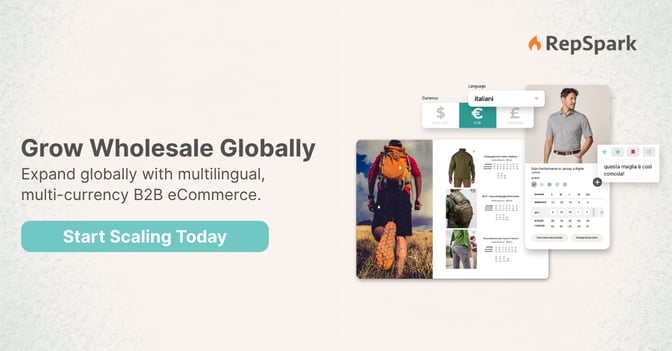
- Multi-currency and multi-language support: RepSpark handles international wholesale operations natively, so your team manages global accounts from a single platform.
RepSpark pros and cons
Pros:
- Pre-built ERP integrations with NetSuite, ApparelMagic, and Shopify Plus reduce implementation timelines and IT burden.
- Dedicated U.S.-based account managers and professional services support brands through onboarding and beyond.
- Insignia tool for custom logo placement and licensed decoration is a native capability not found on competing platforms.
Cons:
- Onboarding is sales-led with a discovery call process, which means it is not a self-serve trial you can activate overnight.
- The platform is designed for wholesale-first brands, so DTC-only operations may find some features less relevant to their model.
- Advanced AI Order Insights and professional services are available on higher-tier plans.
2. JOOR: A digital showroom platform for fashion and luxury wholesale
JOOR has built a large network of fashion and luxury retail buyers. The platform handles digital showroom presentations, seasonal line sheet management, and order capture for brands operating structured sell-in cycles. If your retail partners already have JOOR accounts, the onboarding path for your brand is shorter because buyers are familiar with the interface.
JOOR supports multi-currency operations and offers a curated retailer marketplace for brand discovery. The platform is oriented toward pre-book workflows and collection-based selling common in runway-driven fashion categories.
JOOR features
- Digital showrooms: Customizable online showrooms for presenting collections and seasonal assortments to retail buyers.
- Pre-order and seasonal selling: Built around pre-booking cycles, seasonal drops, and multi-delivery window sell-ins.
- Retailer network access: A curated buyer network that facilitates brand discovery and new account acquisition.
JOOR pros and cons
Pros:
- Widely adopted across the fashion industry, with a large existing retailer base.
- Digital linesheets offer a structured format for seasonal collection presentation.
- Multi-currency and international reach support global selling operations.
Cons:
- Inventory and real-time order tracking can be difficult to manage, according to user reviews on Capterra and G2.
- Integration setup and API configuration require technical resources that smaller teams may not have in-house.
- Platform customization options are limited, which can restrict how brands tailor the buyer experience.
3. NuORDER by Lightspeed: A visual ordering platform for large retailer networks
NuORDER offers digital catalogs, interactive line sheets, and virtual showroom tools for brands managing hundreds of retail accounts. The platform includes drag-and-drop catalog builders and order management features designed to replace manual order capture at trade shows and during seasonal sell-ins.
Since joining Lightspeed, NuORDER sits closer to retailer POS data, which can be relevant for brands selling into larger department store accounts. The platform includes a wholesale marketplace for buyer discovery.
NuORDER features
- Branded wholesale ecommerce portal: A customizable wholesale storefront for presenting products and capturing orders.
- Digital catalogs and line sheets: Drag-and-drop tools for building visual selling materials.
- Promotions and campaigns: Tools for running volume discounts, targeted promotions, and campaigns to retail buyers.
NuORDER pros and cons
Pros:
- Visual catalog tools give brands a retail-style presentation layer for wholesale ordering.
- Centralized hub for products, pricing, and order management across accounts.
- Multi-currency and multi-language support for international operations.
Cons:
- Reporting and analytics capabilities are limited, according to reviews on Capterra and G2.
- Challenges with multi-drop orders and managing multiple delivery months have been reported by users.
- Discount and promotion tools are basic, which can be limiting for brands with complex wholesale pricing structures.
4. ApparelMagic: An ERP-first system for smaller apparel operations
ApparelMagic is an apparel-specific ERP that covers product lifecycle management, inventory tracking, production, and accounting. The system includes a B2B portal module that allows basic wholesale order capture alongside its back-office functions.
For brands that need ERP and wholesale ordering under one roof and do not yet require a dedicated B2B ecommerce platform, ApparelMagic offers a consolidated starting point. The system handles size-color-style matrices and production tracking natively.
ApparelMagic features
- Apparel-specific ERP: Covers production, inventory, purchasing, and accounting in one system built for fashion and apparel workflows.
- Size-color-style matrix support: Handles the dimensional product data that general-purpose ERPs often require workarounds to manage.
- Basic B2B portal: Includes a buyer-facing ordering module for capturing wholesale orders alongside back-office operations.
ApparelMagic pros and cons
Pros:
- Combines ERP and basic B2B ordering in a single system, reducing the number of tools smaller teams need to manage.
- Apparel-native data structures handle size runs, colorways, and production tracking without custom configuration.
- Covers accounting, purchasing, and inventory alongside wholesale operations.
Cons:
- The B2B ordering portal is a secondary feature, not the platform's primary focus, which limits its depth compared to dedicated wholesale platforms.
- Digital catalog and showroom capabilities are less developed than platforms built specifically for wholesale buyer engagement.
- Reporting and analytics tools are oriented toward back-office operations rather than wholesale sales intelligence.
5. Elastic Suite: A pre-book and catalog tool for outdoor and sporting goods
Elastic Suite focuses on digital catalogs, dealer whiteboarding, and pre-book workflows built around seasonal buying cycles. The platform has a concentration of users in outdoor, snow, sporting goods, and footwear categories where seasonal sell-in drives the majority of wholesale volume.
For brands operating structured pre-book programs with specialty dealers, Elastic Suite handles the order capture side of that workflow. The platform is less suited to at-once or in-season reordering that characterizes fast-moving apparel and activewear wholesale.
Elastic Suite features
- Digital catalogs: Tools for building visual product presentations tailored to seasonal pre-book selling.
- Dealer whiteboarding: Collaborative assortment-building features for use during buyer meetings and trade shows.
- Pre-book order capture: Workflows designed around seasonal ordering cycles common in outdoor and sporting goods.
Elastic Suite pros and cons
Pros:
- Seasonal pre-book workflows are a core competency, which aligns with how outdoor and sporting goods brands sell.
- Dealer whiteboarding tools facilitate collaborative selling during market appointments.
- Established user base in outdoor and sporting goods categories.
Cons:
- At-once and in-season reordering workflows are less developed than on platforms designed for ongoing wholesale ordering.
- The platform focuses on sell-in order capture and does not extend into sell-through analytics or post-order visibility.
- ERP integration depth is limited compared to platforms with pre-built connectors for major apparel systems.
Comparison table: The best wholesale software for growing apparel brands
| Platform | Real-Time Inventory Sync | Event Microsites | AI Order Insights |
|---|---|---|---|
| RepSpark | ✓ | ✓ | ✓ |
| JOOR | ✗ | ✗ | ✗ |
| NuORDER | ✓ | ✗ | ✗ |
| ApparelMagic | ✓ | ✗ | ✗ |
| Elastic Suite | ✗ | ✗ | ✗ |
How do you know when your apparel brand has outgrown its current wholesale tools?
The signal is rarely dramatic. Your operations team starts spending more hours reconciling orders between disconnected systems than they spend on growth-focused work. Retail partners call or email to check inventory status because your current platform does not show them accurate stock levels at the point of order.
If your sales reps are manually re-keying orders from PDFs into your ERP, that is a clear indicator. The same applies when your finance team cannot answer basic questions about wholesale margin by retailer without building a spreadsheet from scratch.
Growing apparel brands typically hit this ceiling when their retailer count crosses a few hundred accounts, or when they expand into international markets that require multi-currency and multi-language support. The operational workflows that served your brand at 50 accounts do not hold at 500. A 2026 Truvio report on B2B eCommerce trends found that 88% of manufacturers and wholesalers now take orders online, with digital channels generating over half of B2B revenue.
What should apparel brands look for in a wholesale platform's ERP integration?
The depth of integration determines how much manual work your operations team absorbs every week. A real-time, bidirectional connection between your wholesale portal and your ERP means that orders, inventory levels, customer records, and pricing flow automatically in both directions.
Scheduled syncs, by contrast, create windows where your inventory data is stale. If a large retailer places an order between sync cycles, your team may oversell stock that was already allocated elsewhere. RepSpark addresses this with API-first, pre-built connectors for NetSuite, ApparelMagic, and Shopify Plus that maintain live data accuracy without requiring your IT team to build or maintain custom middleware.
Look for platforms that name the specific ERP systems they connect with and can demonstrate a live data flow during your evaluation, not just a listed integration that runs on a nightly batch.
Why RepSpark is the best wholesale software for growing apparel brands
RepSpark is built for the exact operational stage where growing apparel brands find themselves stuck: your retailer network is expanding, your order volume is climbing, and the tools that worked at an earlier stage now create more work than they eliminate. RepSpark gives you a single B2B wholesale platform that connects ordering, inventory, analytics, and ERP data in real time.
Where other platforms require you to assemble separate tools for catalogs, ordering, inventory visibility, and sales intelligence, RepSpark consolidates those operational workflows into one system. Your retail partners get a branded, 24/7 self-service portal. Your sales reps get AI-driven insights that identify which accounts need attention. Your operations team gets clean order data flowing directly into NetSuite, ApparelMagic, or Shopify Plus without manual intervention.
If you are ready to move past disconnected systems, isolated ERP workflows, and rep-dependent ordering, RepSpark is purpose-built for your next stage of wholesale growth. Book a discovery call to see how RepSpark maps to your current operations and your growth plan.
FAQs about best B2B wholesale software for growing apparel brands
What is B2B wholesale software for apparel brands?
B2B wholesale software is a platform that lets apparel brands manage retailer ordering, inventory, catalogs, and account relationships digitally. RepSpark gives you a branded portal where retail partners place orders against live inventory, 24 hours a day, with account-specific pricing already applied.
When should an apparel brand switch from a basic ordering tool to a dedicated wholesale platform?
The right time is when your team spends more hours reconciling order data than executing growth initiatives. RepSpark replaces disconnected systems with a single wholesale platform that connects ordering, inventory, and ERP data in real time.
How does RepSpark handle complex apparel SKU matrices?
RepSpark manages size, color, and style grids natively, so your retail partners order across dimensional SKU matrices without spreadsheet workarounds. Pre-packs, custom assortments, and seasonal collections are all configured at the account level.
Can wholesale software help reduce order errors for apparel brands?
Yes. Platforms with real-time inventory visibility eliminate the lag between order placement and stock updates that causes overselling. RepSpark connects your wholesale portal directly to your ERP, ensuring every order reflects accurate, live inventory data at the moment of placement.
Does RepSpark integrate with apparel-specific ERP systems?
RepSpark offers pre-built integrations with NetSuite, ApparelMagic, and Shopify Plus, along with flexible API connections for other systems. Every integration runs in real time, keeping inventory, pricing, and order data synchronized across your entire operation.
